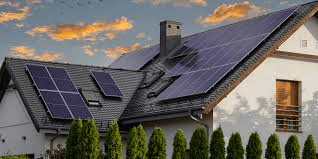
Rising electricity bills and frequent outages push many homeowners to consider A Solar Panel On The Roof Of A House as a practical solution. Rooftop solar turns unused space into a clean energy source that lowers costs and increases home value. This guide explains how it works, what it costs, and how to plan a safe, efficient installation.
## What Does “A Solar Panel On The Roof Of A House” Really Mean?
Installing A Solar Panel On The Roof Of A House means mounting photovoltaic (PV) modules on your roof to convert sunlight into electricity for daily use. These panels connect to an inverter and your home’s electrical system, supplying power in real time and optionally storing excess energy in batteries.
Read too: Is It Reasonable to Ask the Seller to Replace the Roof?
For a technical overview of photovoltaic systems, see:
https://www.wikipedia.org/wiki/Photovoltaic_system
How Rooftop Solar Panels Generate Electricity
- Sunlight hits the PV cells.
- Cells produce direct current (DC).
- Inverter converts DC to alternating current (AC).
- AC powers lights, appliances, and outlets.
- Excess power goes to the grid or batteries.
This happens silently every day with minimal maintenance.
Key Components of a Residential Solar System
| Component | Function |
|---|---|
| Solar panels | Capture sunlight |
| Inverter | Convert DC to AC |
| Mounting rails | Secure panels to roof |
| Wiring & breaker | Connect to home system |
| Net meter | Track energy sent to grid |
| Battery (optional) | Store excess energy |
Why Homeowners Choose Rooftop Solar
Financial Benefits
- Reduce electricity bills by 40–90%
- Federal tax credits and state incentives
- Increase property resale value
Environmental Benefits
- Zero emissions during operation
- Reduce reliance on fossil fuels
- Sustainable long-term energy
Practical Benefits
- Energy independence
- Protection from rising utility rates
- Works during daylight automatically
Is Your Roof Suitable for Solar Panels?
You need:
- South, southwest, or southeast roof exposure
- 200–400 sq ft of clear roof space
- Minimal shade from trees/buildings
- Roof in good condition (10+ years life left)
Roof angle between 15–40 degrees is ideal.
Step-by-Step Solar Installation Process
- Energy audit: Check monthly kWh usage.
- Roof inspection: Structural and shading analysis.
- System design: Decide panel count (often 12–24 panels).
- Permit approval: Local authority + utility company.
- Mount installation: Rails anchored with waterproof flashing.
- Panel mounting: Secure and wire in series.
- Inverter connection: Tie into main electrical panel.
- Inspection & activation: Utility approval to go live.
Timeline: 2–6 weeks including permits.
Typical Costs in the US
| System Size | Home Size | Cost Before Incentives |
|---|---|---|
| 4 kW | Small home | $10,000–$14,000 |
| 6 kW | Medium home | $14,000–$20,000 |
| 10 kW | Large home | $22,000–$30,000 |
Federal tax credit can reduce cost by 30%.
Pros and Cons
Advantages
- Major long-term savings
- Low maintenance
- Clean, renewable energy
- Increases home value
Challenges
- High upfront cost
- Weather-dependent production
- Requires suitable roof
Maintenance Tips for 25+ Years of Performance
- Hose off dust every 3–6 months
- Monitor inverter display weekly
- Trim nearby tree branches
- Schedule inspection every 2–3 years
Solar panels often last 25–30 years.
Real-World Example
A US household using 900 kWh/month installed a 7 kW system:
- Bill reduced from $180 to $25/month
- System paid off in ~7 years
- Added resale appeal when selling home
## FAQ — A Solar Panel On The Roof Of A House
Q1: Do solar panels work on cloudy days?
Yes, but output is reduced. They still generate power from daylight.
Q2: Will panels damage my roof?
No, when installed properly with flashing and mounts.
Q3: What happens at night?
You draw power from the grid or battery storage.
Q4: How long do panels last?
Typically 25–30 years with gradual efficiency decline.
Q5: Can I go off-grid?
Yes, with sufficient batteries, but costs increase.
Q6: Do solar panels increase home value?
Yes. Studies show buyers prefer homes with solar installed.
Conclusion
Installing A Solar Panel On The Roof Of A House is one of the smartest long-term investments you can make. It lowers bills, adds value, and supports clean energy—all using space you already have.
If this guide helped you understand rooftop solar, share it on social media to help others make informed energy choices.

Leave a Reply